
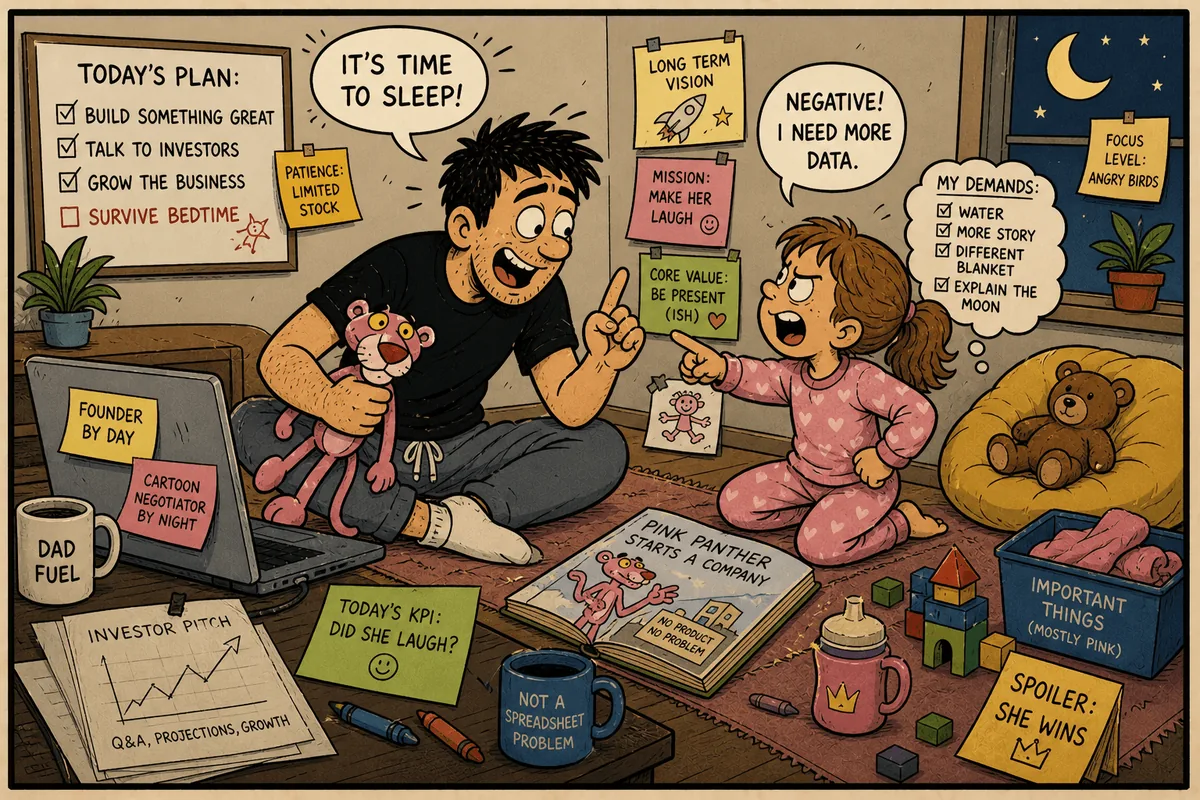
There are two types of meetings that will humble you as a founder, and I didn't realize that until recently.
Investor meetings, obviously, where you walk in thinking you have a story and walk out realizing you mostly have assumptions.
And then there is bedtime.
I've been through both enough times now to know that at least investors let you finish a sentence, or pretend to.
My daughter is four and a half, which is a very specific kind of human — not quite rational but very consistent in her own logic — and unfortunately she has my temperament, which means everything is a negotiation, everything is a question, and nothing gets accepted just because someone said so.
"Because I said so" has absolutely no authority here.
She will either build something one day or take someone apart in a courtroom. I honestly can't tell yet and I'm not sure which outcome is more expensive.
The pivot I didn't see coming
In startups we like the word pivot because it makes chaos sound intentional. The market shifted, users told us something, we adapted — it all sounds like a sequence of decisions made by adults who understand what they're doing.
Fatherhood is not that kind of pivot.
It doesn't come with a decision point. There is no moment where you say okay, this is the new direction, this is the strategy, this is what we are optimizing for now.
One day you are a person who has strong opinions about product and growth and where things are going, and then at some point — without really noticing when — you are sitting on a bathroom floor at 11pm watching Mr. Bean on your phone because it's the only thing that is keeping the situation from completely falling apart over something as simple as brushing teeth.
And you sit there and you think: this is not in any founder handbook I've read.
I didn't pivot. I just slowly got moved into a completely different reality that still somehow runs in parallel with the first one.
Her version of feedback
We spend a lot of time in startups talking about feedback loops and how important it is to get signal from users and not fall in love with our own assumptions.
At home there is no delay, no filtering, no polite layer on top.
"Tata, this soup is bad."
"It's the same soup you liked last week."
"That was a different me."
And that's it. Conversation over. No room for interpretation, no softening.
The annoying part is not even the delivery. It's the fact that somewhere in there she's right. Not about the soup necessarily, but about the idea that people change faster than we want them to, and context matters more than we admit.
In a startup you can hide from that for a while with data and averages and trends. At home you can't.
Resource allocation, but not the kind you can model
At work I spend a lot of time thinking about allocation — where time goes, where money goes, what actually moves things forward and what is just noise that feels productive. There is a framework for that, or at least the illusion of one.
At home I am standing in front of a drawer holding two hair ties and trying to predict which one will create less resistance.
There is a correct answer. I just don't have access to it.
The wrong shade of pink is a real issue — not in a metaphorical way, in a very immediate, very emotional way that escalates quickly if you get it wrong.
I've been in rooms where one conversation could change the direction of the company and I felt more in control there than I do in that moment.
There is no spreadsheet that helps you here.
Focus, the kind that makes you uncomfortable
People in our world talk about focus like it's a skill you can train and optimize. Deep work, no distractions, all the usual things.
My daughter watches Angry Birds with a level of attention that is honestly a bit embarrassing to compare myself to.
There is nothing else happening for her in that moment. No background thread, no mental tab left open somewhere else.
I sit next to her and within maybe thirty seconds my brain is already somewhere else — thinking about something unfinished, something I forgot, something that needs fixing.
She laughs at something on the screen and I realize I missed it.
And it's such a small thing, but it stays with me more than it should. Because it's not about the cartoon. It's about the fact that I was physically there and not really there at the same time.
The bedtime pitch
Every night I run the same process and call it a routine even though it doesn't behave like one.
"It's time to sleep."
It's a weak opening and we both know it.
What follows is a sequence of objections, questions, new conditions that somehow always feel urgent. Water, one more story, a different blanket, a sudden need to understand where the moon goes during the day.
It stretches in a way that most business conversations don't because there is no shared incentive to close it. I've had investor calls with more structure and faster outcomes.
Here there is only patience, or the lack of it.
The version that doesn't get written down
There is a clean version of building a company that people like to share. Long hours, sacrifice, focus, building something from nothing — it has a direction, it makes sense when you tell it after.
What doesn't really get included is how messy it feels in the middle, especially when you are also trying to be present at home — and not just physically, but actually there.
You come back after a day where things didn't move or moved in the wrong direction, and you're still carrying that with you whether you want to or not. And then she runs into you like none of that exists.
For a few seconds, it actually doesn't.
It doesn't solve anything — the problems are still there waiting for you later — but something shifts just enough to remind you that not everything is tied to whether things are working or not.
That part is hard to explain and even harder to include in any kind of narrative.
The only metric that feels real some days
I still track everything, probably more than I should. Growth, churn, conversions — all the things that tell you if you're moving in the right direction or just convincing yourself that you are.
But there are moments where another question shows up almost by accident.
Did she laugh today in a way that wasn't forced or polite? Did we actually do something together without me thinking about what's waiting on my laptop?
Yesterday we built some completely pointless story about Pink Panther starting a company with no product and no clear idea of what it even does. It made no sense at all. She thought it was the best thing ever.
I didn't check my phone for a while and only noticed that after it was over.
Which probably says enough.
I don't have this balanced in any clean way. I still think about work when I shouldn't, I still open my laptop earlier than I planned, I still try to optimize things that don't really need optimizing. Nothing here is figured out.
But I am starting to see that some parts of life don't respond to the same approach that works in a startup, and trying to force it usually just makes it worse.
Tonight will probably look similar to yesterday — some version of negotiation, some version of me being tired and still trying to stay patient. Tomorrow morning I will probably check numbers before I even properly wake up.
Both things seem to exist at the same time and I'm not sure they ever fully separate.
For now, that's just where things are.