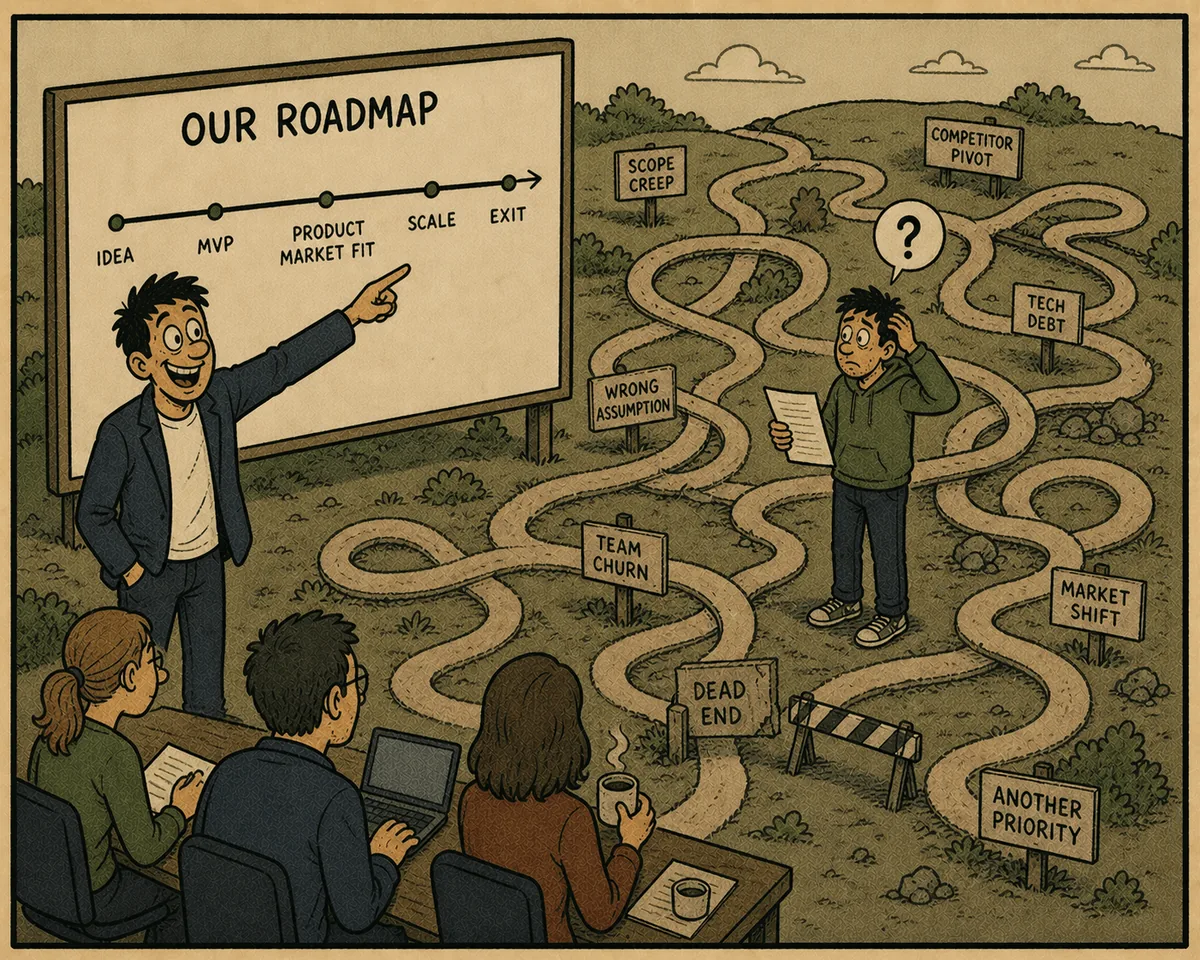
We kept rewriting our roadmap like it was Q2 magic. Turns out, a glossy timeline isn't a plan — it's performance art. But, hey, pretending you're professional can actually unlock momentum. For a while.
Let's be honest: half the job of building a startup is making it look like you know what you're doing. The other half is desperately trying to catch up to that illusion — before your database explodes, your co-founder ghosts, or your roadmap starts gaslighting you.
Nowhere is this more obvious than in the roadmap.
Ah yes. The sacred document. The glossy timeline that whispers, "Q2 will be different." Q2 was not different.
At Serenity, we've written — and rewritten — our roadmap more times than we've checked our Stripe balance. The truth? Most roadmaps are wishful thinking dressed in slide design. A motivational poster disguised as a product plan.
But we keep making them. Because that fake sense of structure? That performative professionalism? Weirdly… it works. For a while.
Managing Like a "Real Company" (Kind Of)
Eventually, you reach that startup puberty stage where you start muttering things like "we need better process" and "should we be using OKRs?" unironically.
So you spin up a Notion hub. You make dashboards. You schedule things like "weekly product review," even though you're the one doing the reviewing and the building.
And weirdly, pretending to be structured actually creates structure. People start caring about timelines. Features ship because someone wrote it down in a sprint doc. You build momentum just by looking like you have it.
That's been the story at Serenity. Start with vibes, back it with tools, pray no one notices you're still duct-taping your way through deployment pipelines.
Roadmaps Are Fiction. But Fiction Can Be Useful.
A roadmap is not a promise. It's a hypothesis.
It's a way of saying: Here's what we think the future might look like if we don't burn out or pivot into a completely different product next Thursday.
Half of what's on it probably won't happen the way you planned. The other half? You'll rename it, re-scope it, or quietly archive it in a Notion board called "Later (maybe)."
At Serenity, we've had ambitious Q1 plans that quietly slid into Q3 like nothing happened. We've built entire features that never made it past staging. We've redefined "B2B" more times than we've redefined "done."
The roadmap still matters. Not because it's accurate, but because it gives your brain — and your team — somewhere to go.
Faking It Until It Stops Feeling Fake
Here's what they don't tell you: structure doesn't come from discipline. It comes from repetition.
At Serenity, we didn't wake up one day with magical product process. We just kept pretending like we had one until, one day, we kind of did.
First it was "what should we build next?" Then it became "what's the roadmap say?" Then we started reviewing things weekly. Then we made a changelog. Then someone (definitely not me) said "velocity" out loud.
And just like that, we became dangerously close to… legitimate. The faking turned into foundation. The illusion turned into inertia. And that's the trick. You fake it — not to fool others, but to pull yourself into the next version of what you're building.
TL;DR
- A roadmap is a strategic lie. Commit to it.
- Fake structure is the seed of real structure.
- "Managing like a real company" means surviving long enough to act like one.
- Nobody knows what they're doing — some people are just better at documentation.
- The roadmap doesn't need to be right. It just needs to be believed.
So yeah. Our roadmap is a lie. But we believe in it. And sometimes, that's all it takes to build something real.