
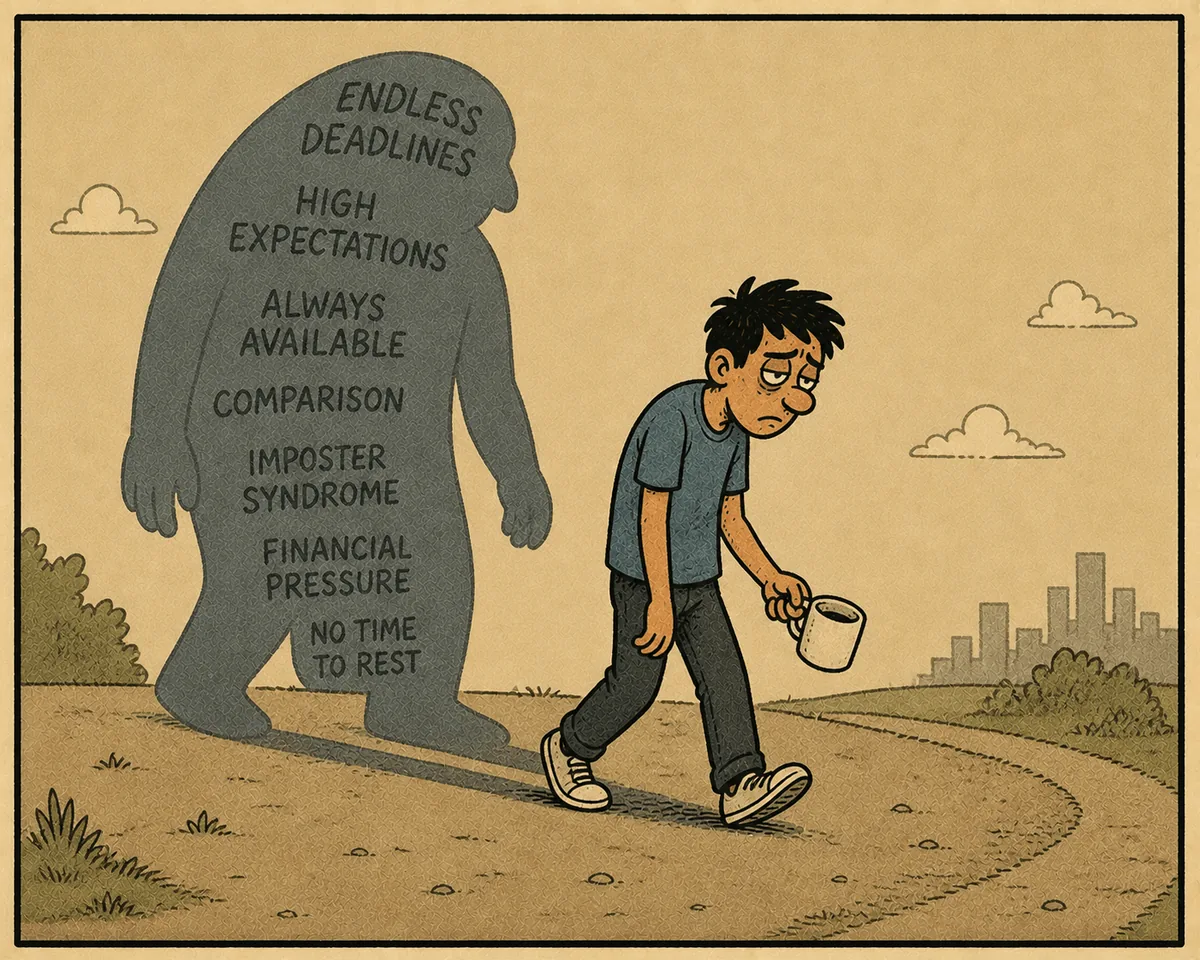
Part I: Welcome to the (Mental) Jungle
Young innovators operate in a state of constant connectivity and chaos. Sleep deprivation is normalized and celebrated — LinkedIn is full of "humbrags" about 4-hour sleep schedules worn as badges of honor.
I tracked my own patterns once and discovered I was operating on just 4 hours of sleep daily while maintaining 14–17 hours of cognitive output for months. Rather than celebrating this, the realization prompted alarm: sacrificing mental health for equity gains is ultimately counterproductive.
Part II: Burnout — The Startup Boss Level Nobody Explained
Burnout is distinct from ordinary stress. It's exhaustion so deep that Netflix feels like calculus. Founders are particularly vulnerable:
- Role Overload: Founders serve as Chief Everything Officer, handling every function simultaneously and remaining perpetually on-call.
- Personal Accountability: Mistakes feel personal regardless of actual responsibility, creating constant self-blame.
- Dopamine Dysregulation: The startup environment functions like a casino — emotional volatility tied to business outcomes, and the house always wins eventually.
The paradox: those who burn out hardest are typically the most conscientious and driven team members.
Part III: Don't Wait for the Crash — Fight Back Early
Four intervention strategies that actually work:
Establish Non-Negotiable Boundaries
I personally block 12:30–3:30 p.m. daily for personal time. Companies won't implode during reasonable breaks. The calendar doesn't care — you have to.
Reframe Leadership Mindset
Founders should adopt team captain mentalities rather than superhero narratives. Delegation and trust over personal omnipresence. You're not the product — the product is the product.
Prioritize Mental Health Infrastructure
Treat psychological well-being with the same urgency as system maintenance. Schedule therapy and reflection as non-negotiable appointments, not nice-to-haves.
Celebrate Rest Rituals
Make recovery activities as ceremonial as business milestones. Normalize adequate sleep and time off. Rest isn't weakness — it's how you survive long enough to win.
Part IV: The Real Win? Surviving and Scaling
Burnout threatens not just individuals but entire organizations. When founders collapse, innovation pipelines collapse with them. The solution requires cultural change — normalizing boundaries, discussing burnout openly, and demonstrating to investors that sustainable practices strengthen rather than weaken companies.
Protect the only asset you truly can't replace: you.