
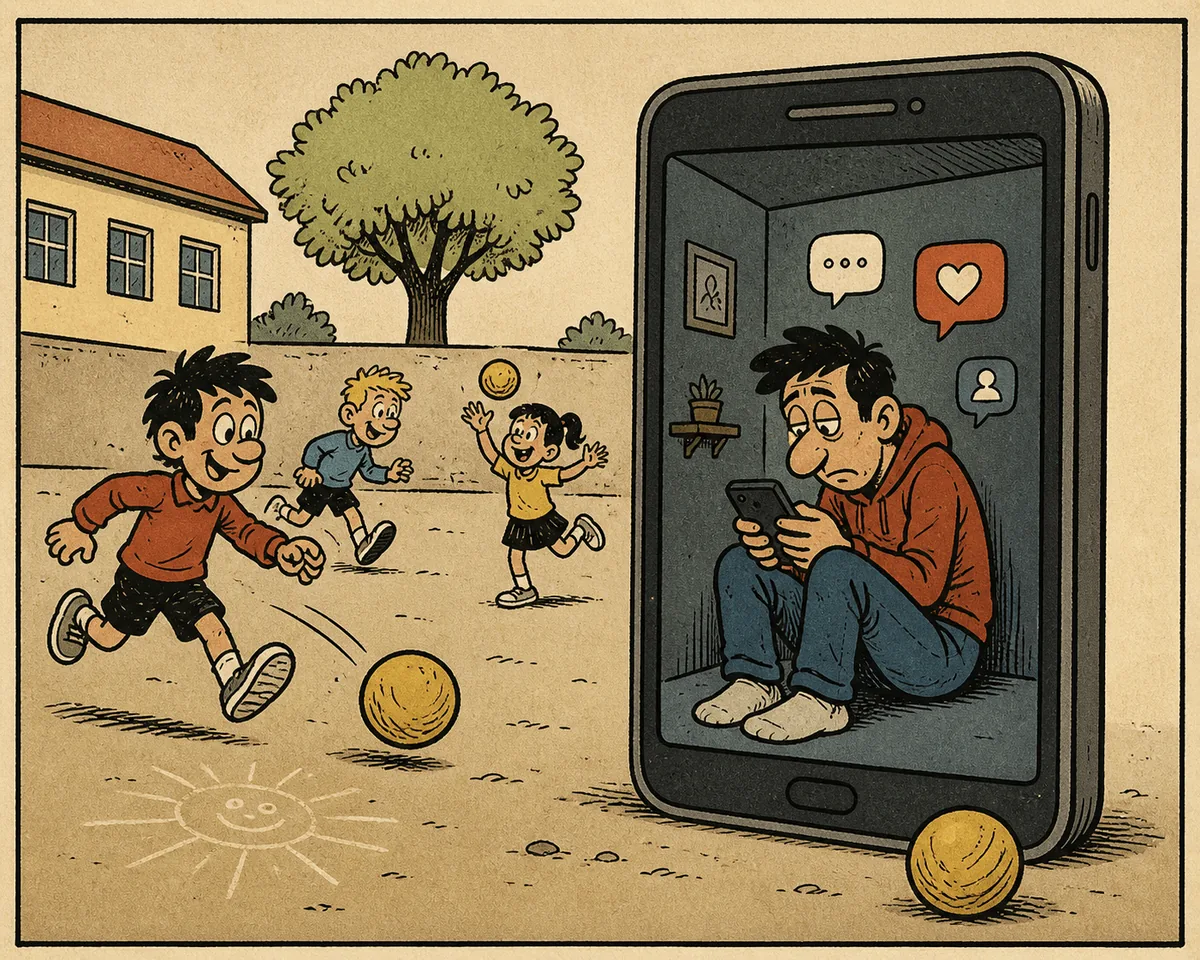
Every generation adapts to its world, but the shift between Millennials and Generation Alpha represents a fundamental transformation rather than gradual evolution.
Millennial Childhoods: The Analog Era
Millennials spent formative years outdoors in neighborhoods where streets served as play spaces. Limited technology meant imagination filled the voids. They learned to navigate libraries, manage dial-up internet, and coordinate meetings without real-time communication — punctuality was essential without technological safety nets.
From Asphalt to ADSL
The internet's arrival marked more than technological progress; it fundamentally altered how humans process information. Research that once required library visits and manual note-taking suddenly became instant through Wikipedia and search engines. Information transformed from scarce to infinite. Friction disappeared.
Social media platforms redirected internet use from knowledge-seeking toward social validation, despite unlimited access to learning resources. Ironically, increased convenience tools haven't guaranteed better time management — Millennials who arrived punctually without mobile phones now run late despite GPS and calendar reminders.
From Wikipedia to ChatGPT
Information retrieval evolved from searching and filtering to AI-generated synthesis. The cognitive skill shifted from locating answers to formulating effective prompts.
Generation Alpha: Native to the Algorithm
Generation Alpha has never experienced life without touchscreens, streaming services, or algorithmic personalization. Their digital fluency feels instinctive rather than learned. Immediacy isn't an expectation — it's reality.
This constant stimulation reshapes cognition. Information consumption occurs in abbreviated bursts. Visual processing often supersedes textual engagement. Instant feedback becomes standard; waiting feels unnatural.
Career perspectives align with these patterns. Flexibility, speed, and personalization appeal more than stability, hierarchy, and conformity. Traditional career trajectories may seem outdated.
Notably, this generation demonstrates greater emotional openness regarding mental health challenges. Western data reveals rising anxiety and depression among adolescents. Screen exposure, social comparison, academic intensity, and global uncertainty contribute to these trends.
Unlike the resilience narrative surrounding Millennials, Generation Alpha sometimes receives characterizations as more emotionally sensitive. However, sensitivity reflects heightened awareness and reduced stigma surrounding mental health disclosure rather than weakness.
The Psychological Transmission
Millennials — shaped by digital culture and comparison pressures — now parent Generation Alpha. Many struggle regulating their own screen habits while establishing boundaries for children in increasingly stimulating environments. Parenting patterns transmit through modeling; children internalize their parents' relationship with technology.
The paradox is striking: Millennials transitioned from scarcity to abundance, while Generation Alpha enters directly into excess without experiencing constraint.
Scarcity cultivates patience. Excess demands self-regulation.
Different Challenges, Not Better or Worse
Millennials adapted to changing world conditions. Generation Alpha navigates environments that transform hourly.
Millennials developed search competencies. Generation Alpha must master filtering.
Millennials encountered boredom. Generation Alpha experiences overstimulation.
Millennials feared missing out. Generation Alpha fears invisibility.
The crucial question isn't generational superiority — it's whether evolution matches acceleration.
Technology doesn't damage inherently; it amplifies tendencies, attention patterns, vulnerabilities, and capabilities. The journey from asphalt playgrounds to algorithmic systems represents neurological, cultural, and psychological transformation simultaneously.
The narrative continues developing.